
Two different squares are often confused
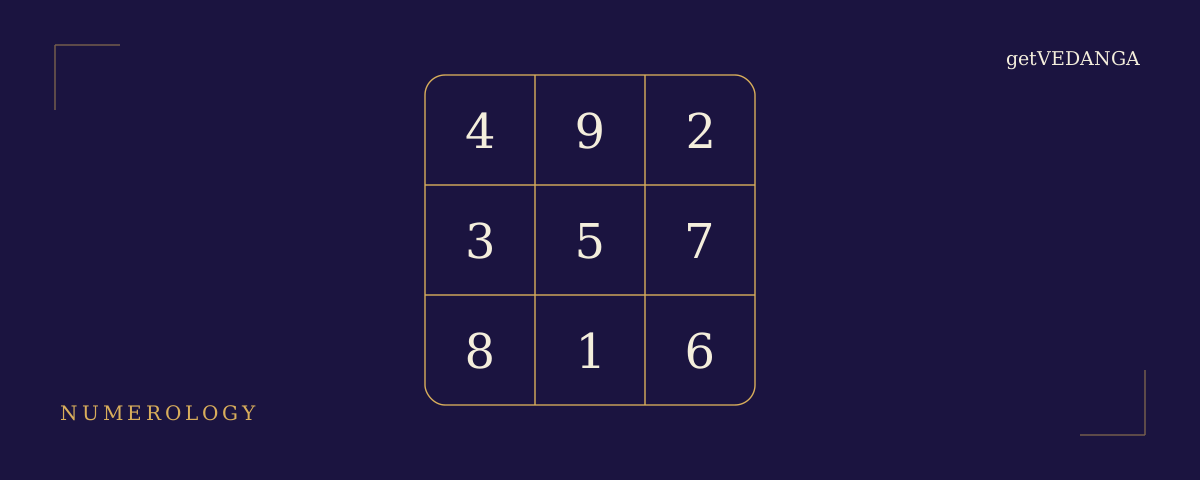
The familiar Lo Shu arrangement places 4, 9, 2 in the top row; 3, 5, 7 in the middle; and 8, 1, 6 in the bottom. When each digit appears once, every row, column and main diagonal totals 15. A birth-date grid is a different object: it puts the digits from a particular date into those fixed cells. Some cells are repeated and others are empty, so its sums do not generally remain 15.
Build the grid without inventing digits
Write the date in a clearly stated format and collect its digits. Omit zeros for this version. Each nonzero digit is placed in the cell assigned to that number; repetitions stay in the same cell. Do not move a missing number from another row to make the diagram look balanced. A useful calculator shows both the original date and the arrangement so anyone can reproduce the result. The pattern is a representation of the input, not a new measurement about the person.
A concrete example
For the date 17 September 1950, written 1950-09-17, the nonzero digits are 1, 9, 5, 9, 1 and 7. The grid therefore contains two ones, two nines, one five and one seven. The zero is omitted. The cells for 2, 3, 4, 6 and 8 remain empty. Changing the display order of year, month and day does not change these counts, provided the full year is retained. Using a two-digit year would change the result and must not happen silently.
What missing and repeated numbers mean here
A missing digit means only that it was absent from the chosen date representation. A repeated digit means it occurred more than once. Numerological schools attach symbolic themes to these patterns, but the grid does not demonstrate a deficiency, a special talent or a diagnosis. Avoid language that turns an empty cell into a personal fault. The strongest use of the diagram is to understand the arithmetic and, if desired, use its symbolic themes as optional reflection prompts.
Keep the systems separate
A Life Path number reduces the date to a number. A Chaldean name number assigns values to Roman letters. A Lo Shu grid counts date digits in a fixed arrangement. They can appear together in one numerology tool, but they are not interchangeable calculations and one does not verify the others scientifically. If a website adds a number derived from a name to the date grid, that is an additional convention that should be explicitly named. Our basic grid uses the date digits only.
A line in the grid is still a convention
Some numerological interpretations give names to rows, columns or diagonals and describe patterns of missing or repeated digits. If you explore those descriptions, ask which school supplied the labels and whether a different website uses the same arrangement. A row containing three occupied cells is an observable feature of the diagram. Calling that row a plane of a person’s abilities is an additional interpretation. Keep those statements separate, especially when a description sounds like a diagnosis or a prediction about education, work or relationships.
Try a small learning exercise
Write the full date and keep the intermediate sum before reducing it. Calculate the birthday number separately. If you add a name, write each Roman letter and its Chaldean value rather than skipping straight to the final number. Finally place the nonzero date digits in the Lo Shu arrangement and count the repetitions. You now have three distinct outputs from clearly different operations. If a symbolic meaning is interesting, use it as an optional question; do not treat agreement between the outputs as independent scientific confirmation.
The method used on this site
The date calculation sums all birth-date digits and optionally retains 11, 22 and 33. Chaldean names use a fixed A–Z mapping from 1 to 8, then reduce the compound sum. Lo Shu places nonzero date digits into a fixed 3×3 arrangement. These are symbolic traditions, not scientific personality tests.
Frequently asked questions
Can spelling change a name number?
Yes. The Chaldean calculation uses the letters entered. Different Roman spellings or transliterations can change the sum without changing a date-based Life Path.
Does a missing Lo Shu digit identify a personal flaw?
No. It states that the digit is absent from the chosen date representation. A symbolic interpretation is not a scientific personality assessment.
Where can I check the calculation used here?
Open the related Free Numerology Calculator tool and its explanation, then compare the settings with the methodology page. The calculation and its traditional interpretation should not be treated as the same kind of claim.
Is this medical, legal or financial advice?
No. The journal explains cultural and symbolic frameworks. A horoscope, numerological pattern or card draw should not replace appropriate practical evidence or professional help.
Sources and further context
Sources have different roles: astronomical documentation supports the calculation, while traditional texts describe a historical framework. A citation does not by itself validate a personal prediction.
Astrology is offered for reflection and cultural interest, not as medical, legal or financial advice. How we work →